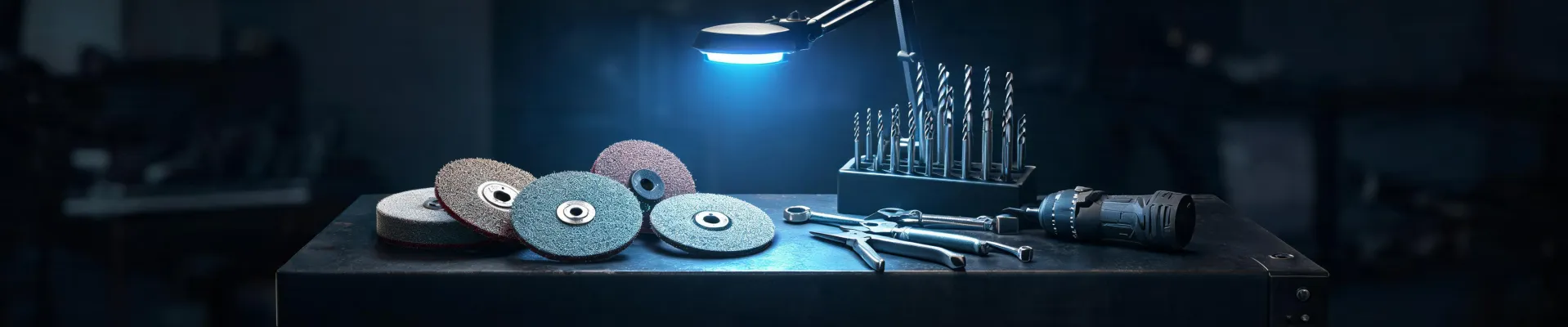
Why there is no single best Norton abrasive disc
If you've ever stood in a supply room holding two 4.5-inch discs that look almost identical, you know the problem. One cuts clean and fast. The other glazes, wobbles, or dies halfway through a cut. The difference is not brand magic. It is grain, bond, thickness, reinforcement, and max RPM.
I am a quality and brand compliance manager at an industrial distribution company. I review every abrasive SKU before it reaches customers—roughly 220 items a year. Maybe 240, I would have to check the system. I rejected about 12% of first deliveries in 2024 due to grit, bond, or max RPM mismatches. That number was 10%—no, 12%, I am mixing it up with last year. The point is simple: most problems start before the disc touches metal.
Honestly, I am not sure why some shops still treat abrasives like a commodity. My best guess is that the label is small and the price is visible. But the cost of a wrong disc rarely shows up on the invoice. It shows up as rework, scrap, or a safety incident.
The four scenarios that cover most angle grinder accessory decisions
Most choices fall into one of four situations. I will keep it to four because five or more usually means the buyer has not defined the job yet.
Scenario A: Mild steel cutting in a fab shop or on a job site
You are cutting mild steel plate, angle iron, rebar, or pipe. You want fast, cool cuts with a 4.5-inch or 5-inch angle grinder. This is the classic home for Norton Abrasives Gemini RightCut. Norton Abrasives, a Saint-Gobain brand, positions Gemini RightCut as a cut-off wheel for ferrous metals. According to Saint-Gobain Norton Abrasives product data, these wheels typically use aluminum oxide grain in a resin bond with fiberglass reinforcement.
For this scenario, check three numbers: diameter, thickness, and max RPM. A 4.5-inch wheel with a 1/4-inch thickness is a grinding wheel, not a cut-off wheel. A 0.045-inch wheel is for cutting. Mounting a cut-off wheel on a grinder running above its max RPM is not a shortcut. It is a failure waiting to happen. According to OSHA 29 CFR 1910.215, abrasive wheel machinery must be guarded and inspected. ANSI B7.1 also covers safety requirements for abrasive wheels. Norton prints max RPM on every disc. Read it.
If you are cutting anchor bolts for base plates, you probably already have an anchor bolt catalogue pdf open on your phone. That is good. Match the disc to the steel, and match the bolt to the embedment and torque spec. The abrasive does not fix a wrong anchor bolt.
Scenario B: Stainless steel or contamination-sensitive work
This is where a general-purpose cut-off wheel can cause trouble. Carbon steel contamination on stainless can lead to rust bloom and rejected welds. You need a disc labeled for stainless or INOX. Norton Abrasives Saint-Gobain offers stainless-specific lines, and the label will usually say iron-free, chlorine-free, or stainless. Do not assume a standard Gemini RightCut is the right call here. It might cut, but the contamination risk is real.
People think expensive discs are better. Actually, discs that perform consistently can command premium. The causation runs the other way. A stainless-specific disc costs more because it solves a specific problem: avoiding contamination. If you are welding 304 or 316 stainless for a food plant, that premium is cheap insurance.
That said, I have seen shops use one disc for both carbon and stainless and get away with it for years. At least, that has been my experience with non-critical structural work. For sanitary, marine, or pharmaceutical work, I would not risk it.
Scenario C: Weld blending, grinding, and finishing
Cutting is only half the job. Once the weld is down, you need to blend it. This is where flap discs, grinding wheels, and coated abrasives come in. For heavy stock removal, a grinding wheel or a coarse flap disc works. For blending and finishing, a flap disc usually wins because it runs cooler and leaves a more consistent scratch pattern.
A typical sequence for mild steel might be a 40 or 60 grit flap disc for blending, then 80, then 120 if you are prepping for paint. Do not jump from 36 grit to 120. You will chase scratches for an hour. Norton Abrasives makes flap discs under BlueFire, Gemini, and other lines. The exact product depends on your grinder and your finish target.
It is tempting to think you can just compare price per disc. But a $3 disc that lasts half as long costs more per weld. A $6 disc that keeps cutting and does not glaze can be the cheaper option. Track cost per cut or cost per finished weld, not cost per box.
Scenario D: Masonry, concrete, and mixed-site work
You are cutting block, brick, concrete, or tile. This is not the place for a metal cut-off wheel. You need a masonry wheel or a diamond blade. The same angle grinder may be used, but the accessory is different. For concrete, a diamond blade with the right bond hardness for the aggregate matters. For block, an abrasive masonry wheel is often enough.
On mixed sites, angle grinder accessories get borrowed, swapped, and lost. That is why I recommend a simple color code or a locked cabinet. In our Q1 2024 quality audit, we found that most returns were not manufacturing defects. They were wrong-disc selections. A worker grabbed a metal cut-off wheel for a concrete task, or a 7-inch wheel for a 4.5-inch grinder. The disc did not fail because it was bad. It failed because it was misapplied.
What angle grinder discs are made of, and why it changes your choice
An angle grinder disc is not a single material. It is a composite. The main parts are abrasive grain, bond, and reinforcement.
- Abrasive grain: Aluminum oxide is common for general metal. Zirconia alumina and ceramic grain are tougher and last longer in heavy grinding. Diamond is used for masonry and concrete.
- Bond: Resin bond is standard for cut-off and grinding wheels. Vitrified bond is more common in bench grinding wheels, not portable angle grinders.
- Reinforcement: Fiberglass mesh gives many cut-off wheels their burst strength. More layers usually mean more strength, but also more thickness.
- Backing: Flap discs and coated abrasives use cloth, paper, or fiber backing. The backing affects flexibility and heat resistance.
This is why the phrase 'a disc is a disc' is a costly oversimplification. Two 4.5-inch discs can have different grain, bond, thickness, and max RPM. They are not interchangeable just because the arbor hole fits.
How to tell which scenario you are in
If you are still unsure, run this checklist before you order or mount a disc. It takes five minutes. Five minutes of verification beats five days of correction.
- Material: Mild steel, stainless, aluminum, cast iron, concrete, or masonry? Write it down.
- Task: Cutting, grinding, blending, or polishing? Each task has a different ideal accessory.
- Grinder specs: What is the max RPM, arbor size, and wheel diameter? A 4.5-inch grinder does not take a 7-inch wheel.
- Contamination risk: Is stainless or aluminum in the mix? If yes, use a dedicated disc.
- Volume and finish: One cut or 500 cuts? A rough weld or a painted finish? The answer changes the grit and the product line.
- Safety standard: Does the disc meet the relevant standard and list a max RPM at or above your grinder? Check OSHA 29 CFR 1910.215 and ANSI B7.1 for the general requirements. Check the Norton Abrasives label for the specific disc.
If you can answer those six, you are probably in Scenario A, B, C, or D. You are not in a mystery scenario. You just have not defined the job yet.
The prevention habit that saves the most money
I am biased here. I review specs for a living. But the data in our own returns is hard to argue with. Most abrasive problems are preventable. Wrong arbor. Wrong RPM. Wrong material. Wrong grit. None of those are manufacturing defects.
So here is the habit I push: verify before you mount. Check the disc label against the grinder label. Check the material against the disc type. If you are buying for a crew, put the right discs in the right bin and label the bin. It sounds basic. It is also the cheapest insurance you can buy.
And if you are still comparing Norton Abrasives to another brand, do not start with price per disc. Start with cost per cut, cost per finished weld, and safety record. The cheaper disc is rarely cheaper once you count the rework.

Maren Jorgensen
Maren Jorgensen is an independent hand tool and torque applications analyst covering wrenches, pliers, screwdrivers, hammers, sockets, ratchets, hex keys, and tool sets. She applies ISO 6789-1 torque-tool conformance principles while examining jaw capacity, leverage, fastener engagement, torque range, accuracy, handle geometry, and material hardness. Her practical guides help tradespeople and procurement teams select suitable tools, plan controlled tightening, and compare durability without relying on brand reputation alone.
Leave a Reply