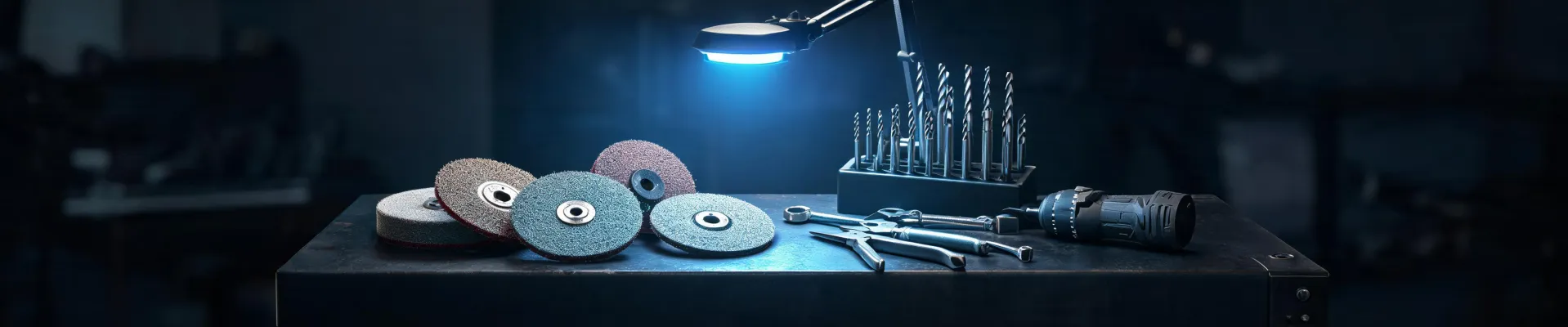
I've coordinated emergency deliveries of industrial abrasives for over 15 years. When a fabrication shop in Houston calls at 4 PM asking if I can get them 200 Norton Abrasives BlueFire R821P flap discs by 6 AM, the last thing on my mind is which wheel costs less. The only questions that matter are: will it do the job, will it be safe, and can we get it there in time?
Here's my unpopular opinion: if you're choosing grinding wheels based on unit price, you're not saving money — you're just deferring the cost. I've watched this pattern play out dozens of times, and the math never ends well for the buyer.
The Sticker Price Is the Smallest Number on the Real Invoice
Let me be upfront about what I don't know. I'm not a metallurgist, so I can't break down the grain structure of a BlueFire wheel versus a competitor's, and I won't pretend to. What I can tell you, from processing literally hundreds of rush orders, is how wheel choices ripple through a job's actual cost.
Labor Costs Dwarf Wheel Costs — Always
A 4.5" cut-off wheel for a Makita 9557NB angle grinder runs maybe $2 to $4. The fabricator running that grinder costs $25 to $45 per hour, fully loaded. If a bargain wheel wears out twice as fast, you're not just buying more wheels — you're paying for the labor to swap them, the downtime in between, and the inconsistent cut quality from a wheel degrading at the wrong rate.
Last March, a metal fabrication shop in Houston switched to a no-name brand to save $1.20 per wheel on their 7" angle grinders. Within a week, I got the call — always the same call, honestly — asking if we could rush-ship a pallet of Norton wheels because their crews were burning through the cheap ones 40% faster. The $180 a month they saved on wheels turned into roughly $4,000 in extra labor and lost productivity. It took a second-round emergency order to make them switch back, but they did the math eventually.
The part people don't expect: cheap wheels don't just fail faster. They fail inconsistently. One wheel lasts 40 cuts, the next lasts 12. That unpredictability means operators can't plan around tool wear. They stop mid-task, which pushes the whole job schedule sideways. Nobody puts a line item on a P&L statement for scheduling chaos, but it's one of the most expensive side effects of buying cheap abrasives.
Type 1 Wheels Carry Real Safety Requirements
If you've ever asked "what is a type 1 grinding wheel," you're ahead of a lot of buyers I deal with. Type 1 wheels are the flat, straight-sided wheels used for cutting and light grinding on angle grinders. They have a specific profile, specific mounting requirements, and — this is the part people skip — maximum operating speeds defined by ANSI B7.1, the US safety standard that governs abrasive wheel design and use.
Putting a Type 1 wheel rated for 6,600 RPM on a 7" angle grinder that spins at 7,000 RPM is a gamble where the payout is a high-speed fragment to the face or chest. I'm not a safety engineer, so I can't recite the full ANSI spec from memory — but after one near-miss where a mismatched wheel came apart in a customer's shop, I don't need to. That moment taught me more about risk cost than any spreadsheet ever could.
Dodged a bullet on that one. We caught the mismatch during a pre-delivery inventory check, and I still remember how close it was to a very different phone call. That kind of incident doesn't show up on a cost-per-unit comparison, but it's real, and it follows a shop around for years in the form of insurance premiums, OSHA scrutiny, and reputational damage.
What Emergency Orders Teach You About Real Cost
You learn a lot about total cost by handling the failures of "cheap" buying decisions. Last quarter alone, my team processed 47 rush orders for Norton Abrasives with 95% on-time delivery. That's not a flex — that's the price of being the guy they call when the line is down. Behind every one of those rush orders is a client who, at some point, picked the lowest-priced wheel on the shelf and then paid for the consequences.
When a plant needs Norton Abrasives BlueFire R821P discs in 36 hours because a contract deadline is breathing down their neck, the $200 in rush freight is nothing compared to the $15,000 penalty clause they're staring down. The problem was never the freight cost. The problem was the $3 they "saved" per wheel three weeks earlier — and the broken workflow that came with it.
You see this everywhere once you look for it. The shop that "can't afford" premium abrasives is the same shop that pays overtime to fix inconsistent cuts. The buyer who brags about driving wheel costs down 20% is the same buyer whose crew has started hiding their favorite wheels from the supply cabinet so they don't run out at the wrong time. That's not cost savings — that's a tax on morale.
But Isn't Norton More Expensive?
To be fair, I understand why people buy the cheaper option. Budgets are real, and every purchasing manager I've ever met feels pressure to show savings on paper. I've had the uncomfortable conversation where a buyer discovers their "cost-saving initiative" actually raised their cost per finished part. That meeting never gets easier.
Granted, there are situations where a generic wheel makes sense. If you're a hobbyist in your garage with a 9557NB 4.5" angle grinder doing occasional weekend projects, a $1.50 import wheel might genuinely be the right economic choice for you. My experience is mostly with professional operations — shops where grinding is the core of the business, not a side task.
If you run a fabrication shop or a construction crew, the calculation shifts. Your labor costs are fixed, your deadlines are contractual, and your safety record follows you around for years. In that world, the unit price of a grinding wheel is a rounding error compared to what the wrong wheel costs you in labor, downtime, and risk.
I have mixed feelings about rush-order premiums — there's a part of me that thinks they're a tax on urgency. But urgency isn't the root problem. The root problem is treating abrasive purchases as purely transactional instead of a total cost decision.
The Simple Math That Changed How I Buy
I'm not a financial analyst, but I've learned a framework that holds up across every industry I've served:
(wheel price × quantity) + (labor hours × loaded rate) + downtime + rework + safety risk = true cost
If you ignore everything after the first two variables, you'll always pick the cheapest wheel. And you'll always end up paying more somewhere else. Maybe it's a slower job. Maybe it's a failed inspection. Maybe it's a wheel that disintegrates at speed. But it always comes.
The Bottom Line on Abrasive Costs
Last time a client asked me to find them the "cheapest Norton abrasives," I told them they were asking the wrong question. I'd rather talk about cost per completed cut, cost per finished part, and cost per incident. Those are numbers that actually matter to a business.
Here's what 15 years of emergency orders taught me: the cheapest grinding wheel is rarely the cheapest grinding wheel. It's the one that made the buyer feel good at the moment of purchase and then cost them twice its price in labor, three times its price in downtime, and — on a bad day — everything in safety risk.
Take it from someone who delivers the wheels when the "cheap" option fails: measure the whole cost, and you'll rarely go wrong with a product that's properly engineered, ANSI-rated, and backed by a supply chain that can actually get it to you when the deadline is real.

Maren Jorgensen
Maren Jorgensen is an independent hand tool and torque applications analyst covering wrenches, pliers, screwdrivers, hammers, sockets, ratchets, hex keys, and tool sets. She applies ISO 6789-1 torque-tool conformance principles while examining jaw capacity, leverage, fastener engagement, torque range, accuracy, handle geometry, and material hardness. Her practical guides help tradespeople and procurement teams select suitable tools, plan controlled tightening, and compare durability without relying on brand reputation alone.
Leave a Reply