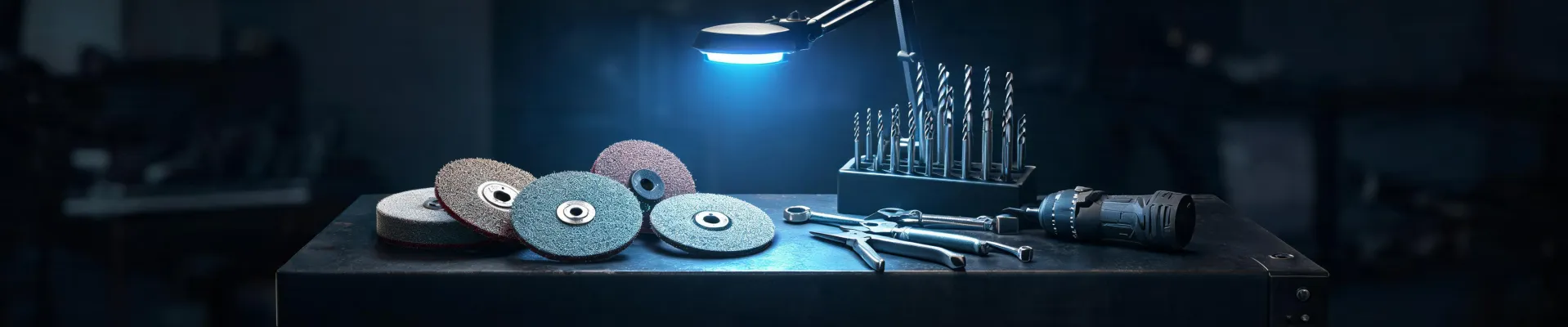
The "Budget" Grinding Disc That Cost Us $8,000
I manage purchasing for a 45-person metal fabrication shop. My job is to keep the floor running without blowing the budget. For years, I thought I was doing a good job—until a single batch of cheap grinding discs nearly cost us a major client.
It started with a simple complaint. Our fabricators kept asking for more cutting discs. "These things wear out in half the time," one of them said. I figured we just needed a better price. So I did what any cost-conscious admin would do: I found a vendor selling bulk grinding discs for 30% less. I placed the order. (That was my first mistake.)
The Problem Isn't the Price. It's Everything Else.
Here's the thing about abrasives: the sticker price is only a fraction of the real cost. When you buy cheap discs, you're not saving money. You're borrowing time from your production schedule—and paying it back with interest.
Low-cost discs cut slower. They wear unevenly. They generate more heat, which can warp thin sheet metal. And they often fail without warning. A fabricator told me he had a disc shatter on him last year. He was lucky—just a few stitches. But that incident triggered an OSHA review and a mountain of paperwork. (Not exactly how I wanted to spend my week.)
The real issue is that most purchasing people—including me—look at unit cost instead of total cost of use. A $2 disc that lasts 10 minutes is more expensive than a $4 disc that lasts 30 minutes. But that math isn't obvious when you're staring at an invoice.
Then there's the compatibility problem. We had guys using the same disc for stainless steel, mild steel, and aluminum. That's a recipe for poor finishes and safety hazards. Proper abrasives are engineered for specific materials. For example, Norton abrasives makes products like the Gemini RightCut line that are designed for fast, cool cutting on specific metals. Using the right disc for the job isn't a luxury—it's basic professionalism.
The Day It All Fell Apart
In March 2024, we landed a rush order for a custom architectural railing. The client wanted it in 10 days. Normally, I'd verify specs and order from our usual supplier. But with the clock ticking, I went with the cheap discs we had in stock. (I knew I should have stuck with Norton, but I thought, "What are the odds it matters for a short job?")
The odds caught up with me. The cheap discs cut hot, left burrs, and clogged constantly. Our fabricators had to stop every few minutes to change discs. What should have taken two days stretched into four. When the client came for inspection, she ran her hand along a weld and frowned. "This feels rough," she said. "I expected better from you guys."
That one comment cost us. We had to rework the entire railing. The overtime, the rush shipping on replacement material, and the discount we gave to keep the client—it added up to about $8,000. Not to mention the hit to our reputation. And all because I tried to save a few hundred bucks on grinding discs.
Oh, and the safety issue? One of the cheap discs exploded during a cut. No one was hurt, but it scared the hell out of the team. That's when I knew I had to change how we bought abrasives.
What I Wish I'd Known About Angle Grinder Safety
While I was cleaning up that mess, I also had to learn a few things the hard way. For instance, how to take angle grinder blade off safely. I'd seen guys just grab the disc and twist. That's a great way to slice your hand open. The right way is to unplug the tool, use the spindle lock, and use a proper wrench. It takes 30 seconds. The shortcuts take weeks of recovery.
We also had issues with sheet metal screws backing out on the railing because our pre-drilling and deburring were sloppy. That traced back to worn-out grinding discs that couldn't produce a clean edge. Everything is connected.
So here's the authority check: Per FTC guidelines, any product claim like "universal fit" or "one disc for all materials" must be substantiated. In my experience, those claims are almost never true. Don't believe them. (Especially for abrasives.)
The Fix: Stop Buying on Price Alone
After the railing fiasco, I sat down with our lead fabricator and our Norton rep. We built a simple standard: for any production job, we use Norton abrasives. Specifically, we stocked up on Norton grinding wheel T1 07660788281 for our bench grinders and Norton Gemini RightCut discs for angle grinders. The difference was immediate.
Cuts were faster. Discs lasted longer. The finish quality went from "good enough" to "client-approved." Our fabricators stopped complaining. And my budget? It actually went down—because we stopped wasting time and material on rework.
I won't pretend it's always easy. Budgets are real. But here's what I tell my peers in purchasing: You can't afford cheap abrasives. The savings are an illusion. The cost shows up later in scrap, delays, and damaged client relationships.
Client perception is everything. When a customer runs their hand over a smooth weld or a clean cut, they're judging your entire operation. A $4 disc that delivers a professional finish is worth every penny. A $2 disc that makes your shop look amateur? That's the most expensive thing you can buy.
So do yourself a favor. Check your abrasive inventory. Talk to your fabricators. And the next time you're tempted to save a buck on grinding discs, remember my $8,000 mistake. It could have been worse.
Look, I'm not saying you need the most expensive option for every job. I'm saying you need the right one. For us, that's Norton. Simple.

Leila Farzan
Leila Farzan is an independent welding, abrasives, and cutting accessories analyst covering welders, electrodes, wire, grinding wheels, flap discs, cutting discs, drill bits, saw blades, hole saws, and router bits. She references ISO 525 abrasive-product dimensions and ISO 9606-1 welding qualification concepts while examining wheel speed, grit, bond, electrode class, duty cycle, kerf, tooth geometry, and material compatibility. Her guides help fabricators choose consumables, control process risk, and compare cut or weld quality.
Leave a Reply